Me and SuperMemo
First contact
When I first heard about SuperMemo, I was in the first grade of high school (1993-94). I don’t remember the exact situation, but I think I overheard two guys from my class talking about a program for learning English. The two guys were Wojtek Dzierzanowski and Michal Ryszard Wojcik. (Michal is, of course, my partner at Antimoon.)
Soon, I learned that Wojtek and Michal were using a program called SuperMemo to memorize English vocabulary. They were typing their words into a “SuperMemo collection”, and the software somehow tested their knowledge.
I had used vocabulary-teaching programs before. On my home computer I had had a program called ETeacher, which worked like this: You would choose a subject (for example, “articles of clothing” or “animals”). Then, the program would show you a Polish word, and you were expected to type in the English translation. Then, it showed you another word, and so on. The program would keep asking until you got all the answers right.
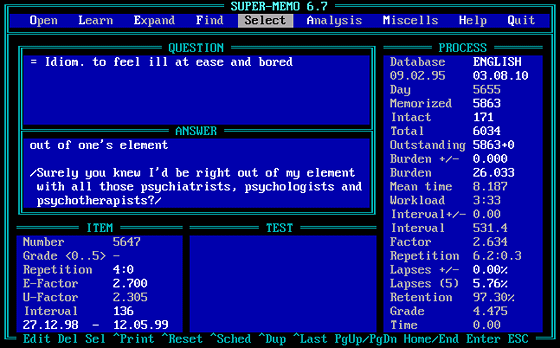
But, my friends told me, SuperMemo was very different and much better than ETeacher and similar programs. Since Michal and Wojtek were both excellent at English, I got interested. Without much hesitation, I got a copy of SuperMemo from Wojtek and ran the program (SuperMemo 6.7 for DOS) on my 286 PC. The main screen looked like this:
Learning the basics
Since I didn’t have any example SuperMemo collections, my only way to learn something about the software was to read the help file. It was fascinating and I read every page of it. The help file explained the basic principles of the SuperMemo method:
- All knowledge has to be reviewed (otherwise it is forgotten).
- SuperMemo allows efficient reviews, because it can compute when and what pieces of knowledge should be reviewed.
I learned the rules of working with SuperMemo. The most important one was regularity — you had to run the program every day or almost every day. The help file even described what sort of lifestyle helps you to learn effectively (lots of sleep, sports, and no smoking).
I also learned the basic technical information on starting a new collection, adding knowledge (which, as I found, had to be represented in the form of question-answer pairs called items), and using the program’s other options. All that reading made me wonder: How effective is this software and what will it be like to use it? I needed to try it out.
My first collection and the evolution of the “perfect item”
I decided to use SuperMemo to study for a phrasal verbs test at my English class. Two weeks before the test, I made a collection with all the words and their Polish translations, and I ran it every day for a week.
I had many impressions from my first experience with SuperMemo. First of all, it was a completely new way to study for a test. Instead of reviewing a list of 100 words, I reviewed only part of the list every day, and each day it was a different part. It wasn’t too much work (perhaps 10 minutes every day), but I had to begin studying earlier than usual and remember to run the program every day.
Second, I was fascinated by the high technology the program represented. I liked the fact that I input the data, and the program, using some mysterious complex magic, knows exactly when I should review each item. I loved to look at the statistics and parameters displayed by the program, even if I didn’t understand most of them! It was a big source of motivation in the beginning: that I (among few in the world) am using such a high-tech tool of the 21st century.
Third, the program seemed to work really well. I noticed that after one repetition, I would remember a word for 2-3 days, but after the second repetition, I would remember it for about 10 days. The intervals (times between repetitions) were growing longer like that. Without SuperMemo, I would never have trusted my memory to keep a word for 10 days. I would have studied the list of phrasal verbs for hours before the test, just like everyone else. Now, it seemed, I could put my trust in SuperMemo.
I passed the test with an excellent grade. Afterwards, I kept using the phrasal verbs collection. I even added some new vocabulary from English classes. All my items were very simple: each had a Polish word in the question part and the English translation in the answer part. They looked like this:
- Q
- kierownica (this is the Polish word for "steering wheel")
- A
- steering wheel
After a few months, I realized that I was no longer satisfied with my collection. In the meantime, I had spent some time discussing SuperMemo with Michal, and I had gotten some new ideas on how to design good SuperMemo items. Now the perfect item was to have the English definition of an English word (taken from an English-English dictionary) in the question part. The answer part was to contain the English word, its phonetic transcription, and as many example sentences as possible (the examples could also be copied from a dictionary). Today, we call this kind of item a definition-word item.
Since the items in my collection did not look like the “perfect item”, I decided to stop using my old collection, and start a new one. In the new collection — I thought — I would do everything right from the start.
So I got an English-English dictionary for my computer (the Random House Webster’s Electronic Dictionary, College Edition), so that I could add example sentences quickly, by copying them into my SuperMemo collection. I also created a special font, so that I could type phonetic transcriptions in the International Phonetic Alphabet into my SuperMemo items (I did not have the ASCII Phonetic Alphabet then). But when everything was ready, I did not have the motivation to add some items. Instead of starting my new collection, I would sometimes open SuperMemo, read the help file, and... get more and more angry at myself for being so lazy.
The GERMAN collection
In September 1994, the new school year started, and I was beginning to take German classes. I was a complete beginner in German. This meant that I would have lots of words to memorize. I planned to add every word I would learn in class to SuperMemo. The first month I would put off SuperMemo (shame on me!) and study German vocabulary the normal way — by reviewing words from a notebook.
Finally, I said enough! and added the whole month’s vocabulary to SuperMemo in two days. From then on, I added everything regularly. And it was worth it. The effectiveness of the program simply swept me away. I could basically remember every word that I had added. I didn’t have to study with a notebook for many hours. The advantage of SuperMemo was especially visible before a test: When everyone else was nervously reviewing their vocabulary from a notebook, the SuperMemo users would sit relaxed, calmly waiting for the test to begin.
The problem with my German collection was this: it didn’t have any sentences. It only had German words and their Polish translations. It was great for passing vocabulary tests and surviving German classes, but it didn’t teach me much German... So, I stopped using the collection as soon as high school finished (and recently, I started a new, much better one).
The ENGLISH collection
Despite my success in German classes, I didn’t feel good about one thing: I wanted to learn English, not German. But I still didn’t have an English collection. The bad feeling grew in me, and in February 1995 I finally started my English collection.
Now I’m going to describe the four years of learning with my English collection:
What I memorized
- Words from classes. For example, if we were reading a Newsweek article in class, I’d write down all the words and add them to my English collection.
- Words from books. I was very active in getting books in English from friends, libraries (there is a British Council library where I live) and bookstores. I’d always use a dictionary while reading to look up the most important words. I would write down all the new words, and then sit in front of my computer, adding them to my SuperMemo collection. I did the same with adventure games on my computer, TV programs, and movies.
If I read or heard a new English word, I just had to add it. For example, when I went to the USA, I walked around with a small notebook. What for? I did not want to forget any of the new words that I learned. I wanted to write them all down and add them to SuperMemo.
How I designed my items
I tried to design my items like the “perfect definition-word item” described above.
- Q
-
= to feel grief or great sorrow
boleć (nad czymś) ← this is the Polish equivalent
{2} - A
-
to grieve [gri:v]
to mourn [mo:rn]
The nation grieved for its war dead.
She's still mourning his death after all these years.
The example sentences in my collection were very important. Probably more important than the definitions. The definitions only told me the meaning of a word. But the examples showed me how to use the word. Thanks to the example sentences, I could write my own sentences with new English words. Many times, when writing a sentence in English, I was writing something very similar to a sentence from my collection.
I was adding more and more example sentences to my items. For example, if I was adding a word from a book, I would add the sentence from the book which contained the word, as well as the examples that I’d find in my dictionary. In some of my items, I had 4 or 5 example sentences!
My problem was that in SuperMemo 6.7 the answer field of an item could only have 255 characters. Sometimes all the sentences would not fit in the field, so I would have to shorten them or even leave some out.
My motivation for using SuperMemo
I used SuperMemo throughout high school. Every single day I would review items for 10-30 minutes. On many days I would spend even more time to add new items (between 30 minutes and 3 hours). Why did I continue to use SuperMemo over all those years?
-
Adding items would give me a feeling of growing power. I felt that each new item
increased my English knowledge. I knew that I would not forget the item, because
SuperMemo would keep it in my memory. So I’d think:
I don’t have to worry about forgetting. My English knowledge depends only on me. If I add a lot of items, I will succeed.
- I felt great when I learned a word with SuperMemo, and then used it. For example, when watching a show on English-language TV, I’d notice all the words that I had recently added to my SuperMemo collection. That would make me feel great — I didn’t have to look the words up in a dictionary — I just understood them! The same happened when I was reading books, or when we were reading something in the classroom.
- My friends were using it. Michal and Wojtek were both users of SuperMemo, and they were excellent at English. I was ambitious and I didn’t want to be worse than my friends.
- Learning with SuperMemo was so different from normal learning that I liked to do it just for a change. If I got bored from reading a book in English for two hours, I could start doing SuperMemo. This let me learn more English without getting bored.
- My collection was the result of many hours’ work. I didn’t want to lose it, so I ran it every day.
- The progress I made with SuperMemo was very motivating. You can read about my results in the next section.
Results of using SuperMemo
My strategy (reading books, watching TV, and making a lot of SuperMemo items) worked. Using SuperMemo improved my vocabulary, but also my pronunciation (my items contained phonetic transcriptions) and grammar (because of all the example sentences in my items). It helped me read books, watch TV, write, speak... it simply helped me in every area of English.
- Because of SuperMemo, I could excel in the classroom. Because I added all the words that were taught in English classes, I knew them very well even months afterwards. So if there was a vocabulary test, it would be very easy for me. Because of reading, listening and SuperMemo, I was also great at grammar tests — I could answer multiple-choice questions in a few seconds, without thinking about grammar rules at all.
- I could impress other people. After 1-2 years, I simply knew a lot of English words and was also very good at grammar. My classmates quickly noticed that I was good at English. They would often ask me to explain English words to them, help them do tests, etc.
- At some point, I could even see that my English was better than my teachers’. The biggest difference was pronunciation (I could tell mine was much more native-like than theirs), but I was also better at vocabulary and grammar: often, I knew a word, and they had to look it up in a dictionary. They had problems with test questions that I could answer. Sometimes they would even give wrong answers, and I’d have to correct them. Usually, they’d argue with me until they checked the correct answer in the key to the test — and then they would get very angry. :-)
More recent experiences
New English collection
In 2001, I stopped using my high-school English collection and started a new one. The new English collection contained two of Antimoon’s new ideas: First, it used the ASCII Phonetic Alphabet for phonetic transcription. Second, it had mainly sentence items. The sentence item is a new type of SuperMemo item in which the question is an English sentence, and the “answer” is your understanding of the sentence. In other words, you add sentences, not words. Sentence items and their advantages are described in detail on another page.
New German collection
In September 2001, I started learning German. In the beginning my knowledge was very poor. After four years of German classes in high school (4 hours a week), and a 4-year break, I couldn’t write a simple four-word sentence! I started very slowly, studying only rarely (about once a week for 1-2 hours). Around April 2002, my speed increased. I started reading books in simple German, playing an adventure game, watching German television, and writing e-mail messages to a German friend. (More on my German learning process in this discussion in our forum.)
Again I turned to SuperMemo. I added about 1,000 sentence items from these sources. In June, I took a basic German exam at the university, and passed it with an excellent grade. Now (July 2002) my German collection has about 1,300 sentence items and about 100 pronunciation items. I run it every day, which takes about 10 minutes.
Today — only 3 months since April 2002 — I can play an adventure game for Germans and understand almost everything. I can write e-mail messages in German with very few mistakes. I can even speak German (slowly and carefully). All this is largely because of SuperMemo — the fact that it helps me keep many correct German sentences in memory.